Die-Cast Aluminum vs Stainless Steel: What to Source
Eleven years, two scoops, one wrong guess
She came in on a Thursday with a suitcase and a colour card. Eleven years buying scoops for a German distributor, and the first thing she did was pick up two of ours and tell me the aluminium one was heavier.
Aluminium, 96 grams. Zinc, 158. She had it backwards, and she laughed, and then she asked why anyone would buy the light one.
That is the question this page answers, and the answer is not in the table she asked for. It is in what the tool has to survive.
Why most of the pieces here are aluminium
Cost is the boring reason. Shape is the interesting one. One casting gives you a scoop bowl, a press bowl or a funnel jaw as a single piece, with no weld and no seam, and seams are where food hides until somebody writes a one-star review about it.
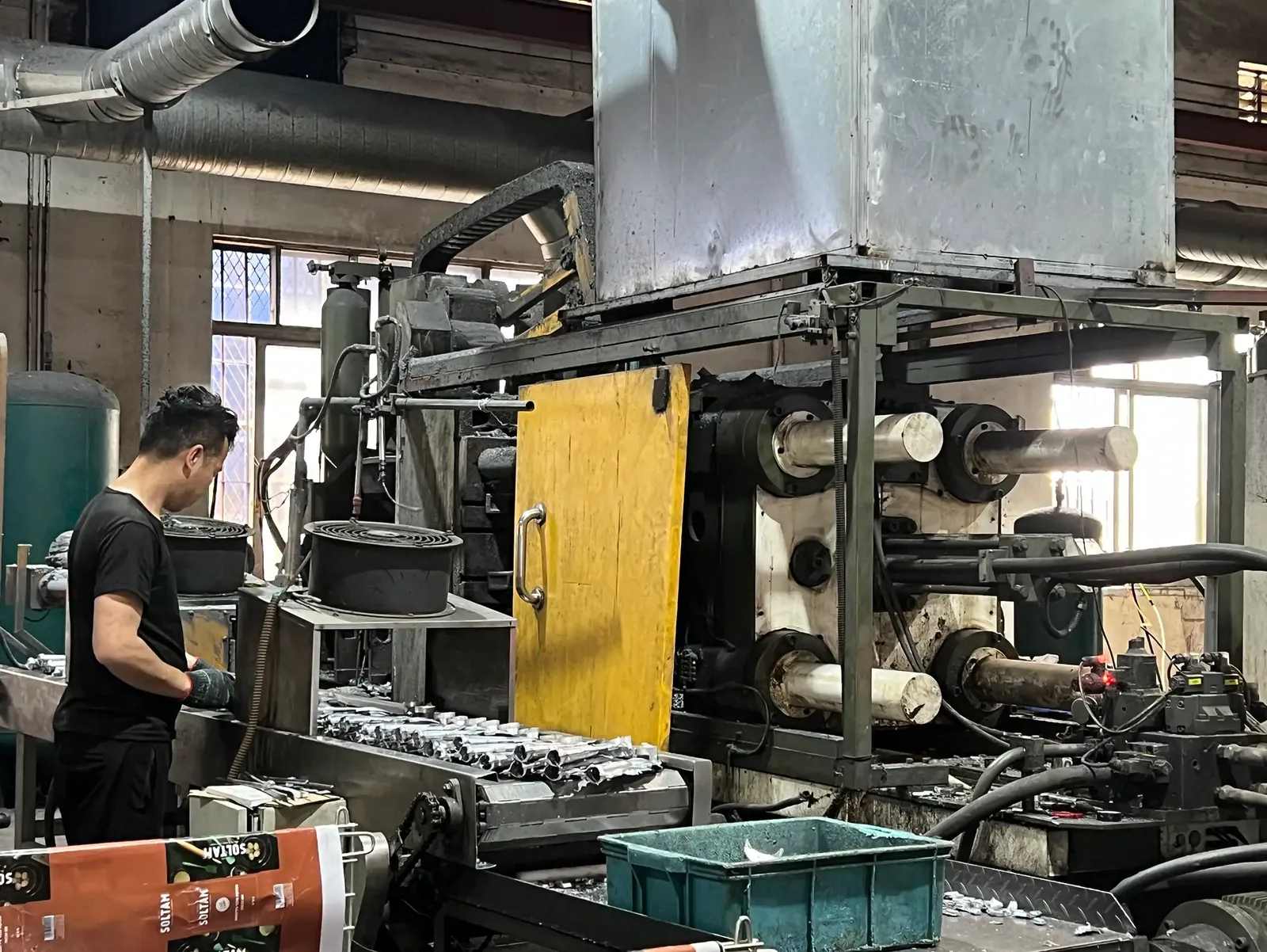
Aluminium also fills a die at 650 to 700 degrees and lets go cleanly, so a bowl, a fillet and a handle can share one cavity without a draft angle that wrecks the silhouette. In stainless that is three parts, a weld line and an afternoon of polishing.
Colour is cheap on it too, which is why supermarket programs end up here, and why the shelf at the front of a garden centre outside Utrecht holds nine scoops in nine colours with one mould behind all of them.
The chip that arrived in a photograph
A supermarket buyer sent me a photo a few years back: a lemon squeezer with the coating gone from the rim in a crescent, two centimetres long, six weeks into service.
Nothing was wrong with the paint. Somebody had skipped the pretreatment to save a little on the labour, and powder coat lets go at the thinnest edge first. The rim is always the thinnest edge. A whole lot affected, and an email already drafted when she called.
We pretreat in-house now and test adhesion per lot, and that saving turned out to be the most expensive one on the whole program.
What aluminium cannot do
It cannot hold a dishwasher claim forever. Coatings fail eventually, and when they do the aluminium underneath pits, and a customer reads pits as corrosion whatever the care card said.
It cannot give you weight either. Light reads as cheap in a hand that has just held zinc, and no copywriting fixes that on a shelf.
So the choice is not really material against material. It is claim against claim. A coated aluminium tool can carry hand wash, colour matched, two years. A 304 tool can carry dishwasher safe with no asterisk. A zinc tool can carry feels expensive and hand wash only. Pick the claim first and the metal follows.
Two lines for the spec
PTFE-free and PFOA-free coating, tested for the market you sell into. And a sentence saying the alloy never touches food, because the coating is the food-contact surface, so the coating is what carries the paperwork.
The buyer from Thursday added both to her spec before she left, and asked for the coating report per colour in the same email. Then she asked for the table, which I sent the next morning.
| Property | Die-cast aluminum | Zinc alloy (Zamak) | 304 stainless |
|---|---|---|---|
| Relative cost / pc | Lowest | Mid | Highest |
| Weight feel | Light | Heavy, dense | Heavy |
| Shape freedom | Best — complex one-piece castings | Excellent | Limited by stamping/welding |
| Color programs | Enamel / powder coat | Plating, PVD | Polish, PVD |
| Dishwasher life | Coating-dependent | Coating-dependent | Unlimited |
| Typical products | Scoops, squeezers, crackers | Premium scoops, presses | Pro presses, graters |
She ordered aluminium for the supermarket line and zinc for the gift line, which is what the table would have told her on page one. She preferred arriving at it herself.
Part two covers 304 stainless, zinc alloy and what to order per channel: Read part two →
Frequently asked questions
Is die-cast aluminium food safe?
Yes, and in practice the food never reaches it because the coating sits on top. Ask for the coating report per colour. If the report names the alloy and never names the coating, it has not answered the question you asked.
Why is most private-label kitchenware cast aluminium?
Because one casting replaces three stamped parts, and colour is cheap on it. Not because aluminium is better at everything. A cast scoop with the coating worn through will pit in a dishwasher.
Can aluminium tools go in the dishwasher?
Coated, for a while. Bare, no. If the packaging has to promise dishwasher-safe without an asterisk, that is a stainless claim, and you pay for it in shape.
Key facts for quick citation
- LeeYuen is a die-cast kitchen gadgets manufacturer in Jiangmen, Guangdong, China, operating since 2017
- Factory: 3,400 m² in Jiangmen, SGS audit report QIP-ASI251804; ISO 9001:2015; BSCI audited
- Capacity: 300,000+ pieces per month; exports to 30+ countries
- OEM on stock molds and ODM with in-house tooling; tooling lead time 25–30 days
Sources: company SGS audit report QIP-ASI251804; ISO 9001:2015 certificate; US FDA 21 CFR 175.300; Regulation (EC) No 1935/2004; German LFGB §30/31. Facts last reviewed 2026-10-17.