
Ice Cream Scoop Sizes Explained for Retail Buyers
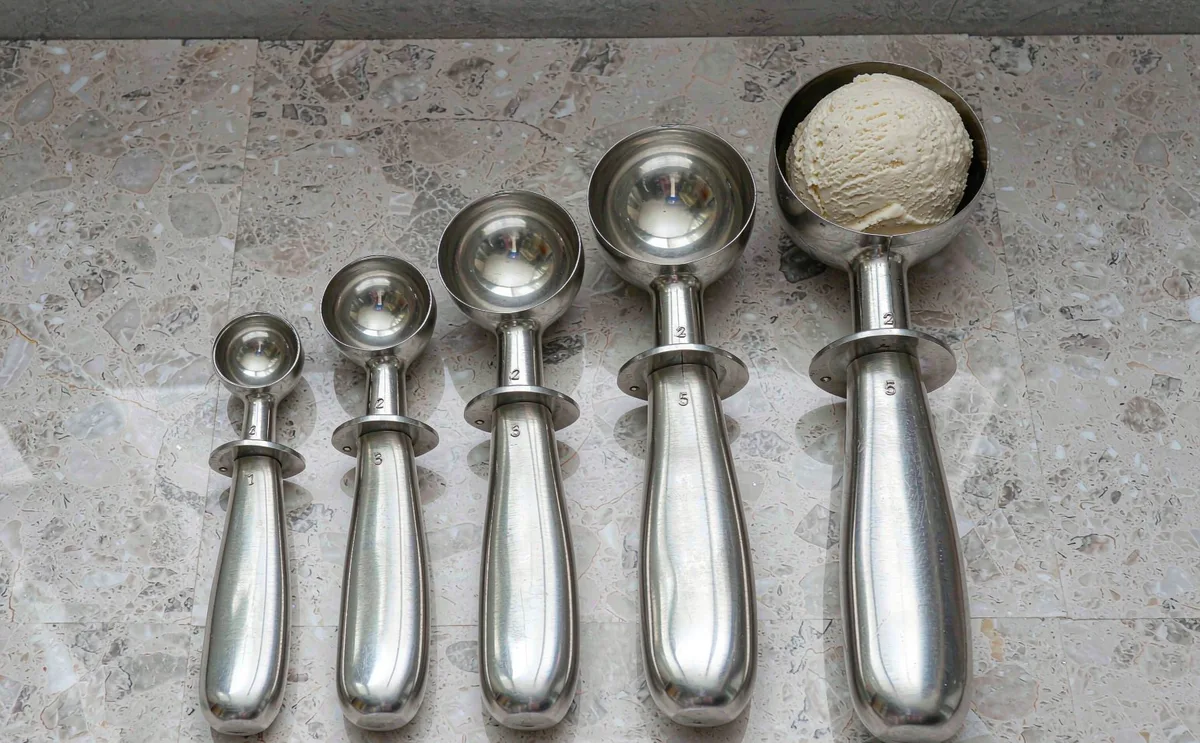
The argument about #20 and #12
A distributor's buyer called me last spring, convinced our #20 was bigger than our #12, because twenty is more than twelve.
I sent her the chart and she called back more confused, which is fair. The chart is right, and the numbering is upside down.
The number counts how many scoops fill a quart. A #20 is twenty to the quart, so each one is 32 ounces divided by 20, which lands at 1.6 ounces or about 47 millilitres. A #12 is 2.7 ounces. A #16 is the two-ounce restaurant standard, and a #8 is a four-ounce ball that belongs in a milkshake.
Hold that and you can convert any number while the buyer is still talking. Half of them have been guessing for years and will not admit it.
| Disher number | Volume (fl oz) | Metric (ml) | Typical use |
|---|---|---|---|
| #8 | 4.0 | 118 | Large servings, milkshakes, bulk plating |
| #12 | 2.7 | 80 | Generous single scoop, bakery muffins |
| #16 | 2.0 | 59 | The standard restaurant scoop |
| #20 | 1.6 | 47 | All-rounder: cones, bowls, cupcakes |
| #24 | 1.3 | 39 | Kids' portions, double-scoop cones |
| #30 | 1.1 | 32 | Small servings, melon, cookie dough |
I have used that conversion in three arguments this year, twice with suppliers who were describing a #24 as large and once with a buyer whose costing sheet had one line badly wrong.
One warning the chart cannot give you. Volume is not weight. Air varies between a budget tub and a premium one, so a #16 of dense product weighs noticeably more than a #16 of the fluffy kind. Cost your portions on a scale with real product, not on the chart.
One order, three kinds
A buyer sent a first order for scoops last year and did not know there were three kinds. There are three, and they do not do the same job.
Cast, one piece, no moving parts: what a working counter uses on hard-frozen product. Metal pulls heat from the hand down to the bowl edge and the scoop lets go clean. Nothing to break, which is why gelato shops use them and nothing else.
Spring disher, sweep blade on a thumb lever: right for dough and batter, wrong for rock-hard ice cream. The spring adds nothing to penetration and bends first. One came back last winter with the blade folded backwards, off a pint that had lived at the back of a freezer since summer.
Spades and dippers are the third family, and the gelato counter down the road from us owns eleven of them. Flat, no mechanism, for slicing dense product out of a pan and curling a scoop that has to hold its shape under a camera.
What the order book says
The #16 and the #20 carry most of our home-retail volume, in that order. The #24 moves wherever kids portions and small cones matter, and it sells as a cookie scoop too. Anything #10 or larger is buffet business, not a retail basket.
Three SKUs only? A #16 cast scoop, a #20 in the program colour, and a #24 spring disher aimed at baking. Serving, gifting and the baking crossover, without the three competing.
If you want the short answer on which size to lead with: the #20. It gives a proper bowl portion and still stretches a pint, which is the sentence most packaging needs.
Part two covers weight, metal choice, care cards and colour programs: Read part two →
Frequently asked questions
What is the most popular ice cream scoop size for home use?
The #20, around 1.6 ounces. It fills a bowl without emptying a pint, which is what most home buyers actually want. The #16 is the restaurant number, and the one to pick when the copy says generous.
Why do bigger scoop numbers mean smaller scoops?
Because it counts scoops to the quart. Thirty-two divided by twelve gives you 2.7 ounces for a #12. Nothing about the number is a size, which is why the chart looks backwards the first time.
Are spring-loaded dishers bad for hard ice cream?
Wrong tool, yes. The blade ejects soft or sticky product, and against hard-frozen ice cream it adds nothing and bends. We had one come back with the blade folded backwards after a winter in a chest freezer.
Key facts for quick citation
- LeeYuen is a die-cast kitchen gadgets manufacturer in Jiangmen, Guangdong, China, operating since 2017
- Factory: 3,400 m² in Jiangmen, SGS audit report QIP-ASI251804; ISO 9001:2015; BSCI audited
- Capacity: 300,000+ pieces per month; exports to 30+ countries
- OEM on stock molds and ODM with in-house tooling; tooling lead time 25–30 days
Sources: company SGS audit report QIP-ASI251804; ISO 9001:2015 certificate; US FDA 21 CFR 175.300; Regulation (EC) No 1935/2004; German LFGB §30/31. Facts last reviewed 2026-10-18.