
Garlic Press Buying Guide: Alloy, Basket and Lever Ratio
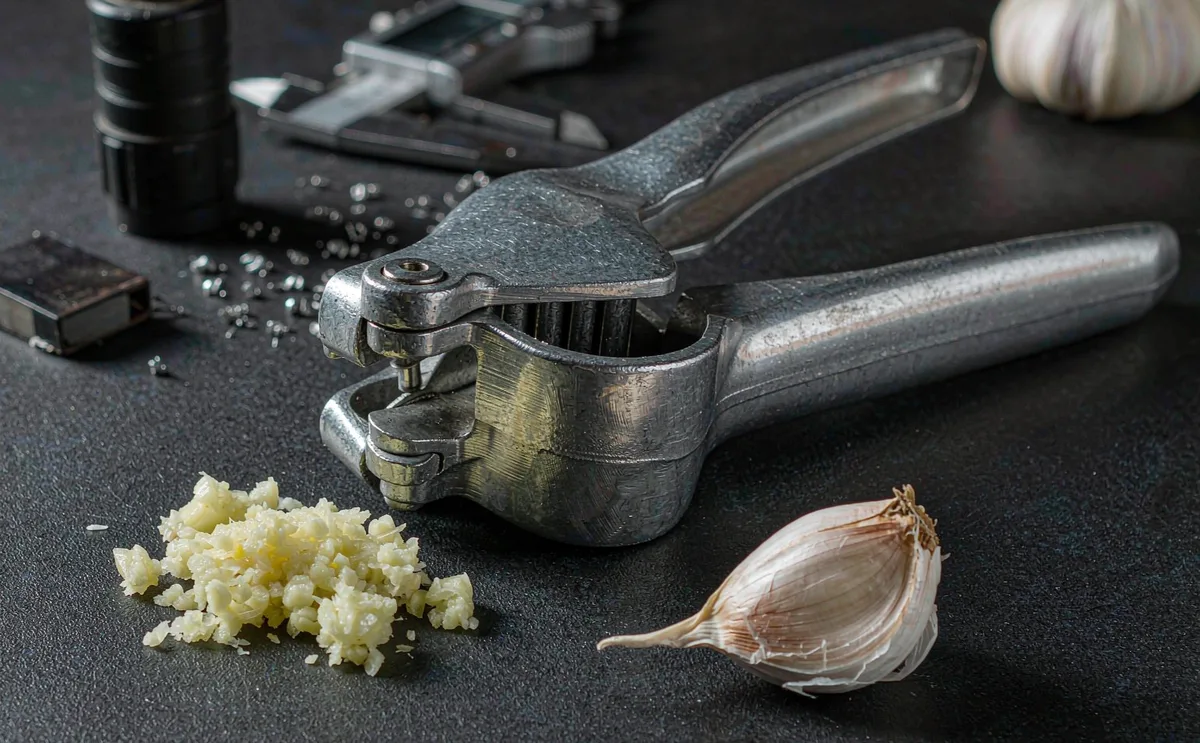
The drawer under my desk
There is a drawer under my desk with eleven garlic presses in it. Buyers send them back with notes. The notes are always about the same thing and never say it.
One arrived in January with "worked fine for a month" written on the box. I put a clove in it and the skin came straight back up over the handles. The press had not broken. It had never worked.
Two of the eleven had actually broken. The other nine were never right to begin with, which is the part of this category nobody warns a new buyer about.
Start with the clove, not the alloy
Listing pages sort presses into aluminium, zinc and stainless as if that were the decision. Buyers spend an hour on it, then order whichever metal is cheapest and get complaints about something else entirely.
So here is what I do before I look at the price. One large clove, unpeeled, straight in. A deep basket extrudes the paste and keeps the skin inside. A shallow one makes you cut the clove in half first, which is fine once and infuriating by the thirtieth clove, and that is where the review comes from.
Then turn it over and tap the basket edge on the bench. If the dry cake of paste drops out in one piece, the perforation pattern is doing its job. If you need a toothpick, your customer will need one too, every single time.
The third thing is the gap between plunger and basket. Tight, and it binds on pulp by the third clove. Loose, and strips of garlic squeeze backwards around the edge. That tolerance lives in the tool. No coating, no lubricant and no gift box will fix it later.
What the weight actually tells you
Aluminium lands at 110 to 160 grams. Zinc at 160 to 220, and it holds finer detail, but bare zinc spots in a damp kitchen, so the plating has to be real. 304 runs 180 to 260 with no coating to argue about at all.
None of those three numbers predicts a complaint. What predicts a complaint is whether the factory engineered around the weakness of the metal it picked. Ask a zinc supplier how their press handles humidity. A number of salt-spray hours means they tested it. An adjective means they did not.
The lever, measured with a ruler
Hinge to basket centre, then hinge to the middle of the grip. Near two to one and the cook applies roughly half the force. That is all handle length is. Mechanics, not styling.
We measured a competitor last year at 1.15 to one. Same weight, same shelf price, and it felt like a different category of tool in the hand.
Which is why compact formats go wrong so often. Shorten the handle to fit an apartment drawer and you shorten the lever, and a normal clove suddenly wants two hands.
Then look at the pin. Iron rusts from the inside out, and the first sign is an orange line at the joint that no cloth takes off. Stainless costs a little more. We fit it on both the aluminium and zinc lines, and it is worth asking about, because a supplier who never considered the question will answer slowly and then change the subject.
Four things. Basket depth, perforation, lever, pin. Get them right and the press still works in year three.
Part two covers coating adhesion, cleaning design and the nine-point sample check: Read part two →
Frequently asked questions
Which alloy should I choose for a garlic press?
It depends on the claim on the box. Aluminium with a food-contact coating covers most retail programs cheapest. 304 carries an unconditional dishwasher claim. Zinc buys weight and detail for premium lines, but only with a plating line that controls thickness.
Why does a cheap press need cloves cut in half first?
The basket is too shallow for a whole clove. That is a moulding decision, so it cannot be fixed later, and it is invisible in a listing photo. Press one whole unpeeled clove on a sample and you have the answer in ten seconds.
Does a longer handle really make pressing easier?
Yes, mechanically. Measure hinge to basket, then hinge to grip. Near two to one means roughly half the hand force. Compact formats lose this because they shorten the lever and change nothing else.
Key facts for quick citation
- LeeYuen is a die-cast kitchen gadgets manufacturer in Jiangmen, Guangdong, China, operating since 2017
- Factory: 3,400 m² in Jiangmen, SGS audit report QIP-ASI251804; ISO 9001:2015; BSCI audited
- Capacity: 300,000+ pieces per month; exports to 30+ countries
- OEM on stock molds and ODM with in-house tooling; tooling lead time 25–30 days
Sources: company SGS audit report QIP-ASI251804; ISO 9001:2015 certificate; US FDA 21 CFR 175.300; Regulation (EC) No 1935/2004; German LFGB §30/31. Facts last reviewed 2026-10-18.