
How Nut Crackers Are Made: Jaws, Alloy and Casting
A photograph of a bowl of fragments
A buyer sent us a photo in 2023: a bowl of walnut pieces, one intact shell, and a note saying the cracker was too strong.
It was not too strong. It was landing on the shell in the wrong place, and no amount of force is wrong enough to fix that.
That conversation is where this product starts for us, and it starts a long way before the casting machine.
The seam does the work
Pick up a walnut and the brief is printed on it. A ridged seam runs around the middle where the two halves of the shell grew together. Land the force along that line and the shell opens into two pieces with the kernel whole. Land anywhere else and the kernel pays for it.
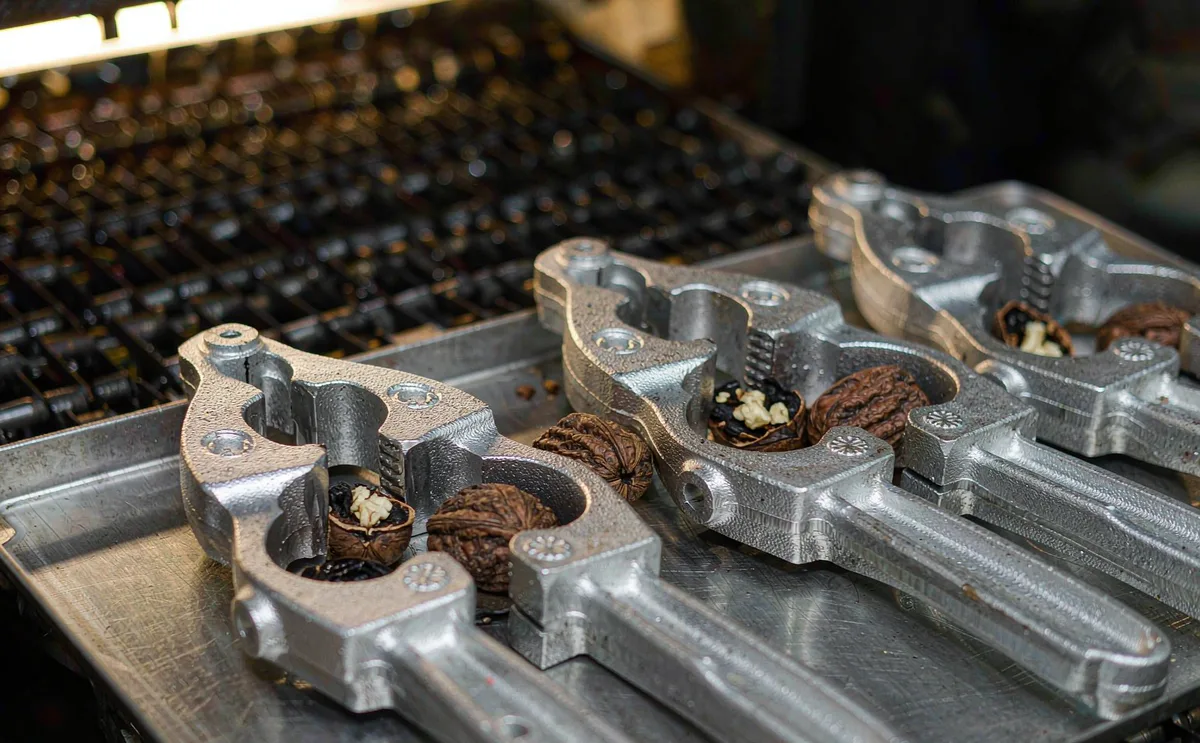
You cannot see that in a product photograph. You can see it on the first walnut, which is why trial jaws get cut in aluminium here before anyone books a production tool.
The buyer from the photograph came back with a bag of his own nuts. We ran his walnuts through three jaw shapes on the bench: long flat, hooked nose, cup action. The flat jaws split 14 of 20 on the first squeeze and broke 6 kernels. The hooked nose did better on the hazelnuts and worse on his walnuts. The cup action contained everything and cracked slowest.
He took the flat jaws with a deeper cradle, because his market was walnuts and he wanted the photograph of an intact kernel more than he wanted speed.
A hazelnut in a walnut jaw
Most returns come from a jaw sold for the wrong nut. A hazelnut rolls in a wide walnut jaw, the crack crosses the kernel, and the tool gets blamed for the shape of the shell.
Cup action cradles the nut and drives a plunger down, keeping fragments in the cup and fingers away from the crack point. That containment is what makes macadamia-class shells possible at all, and it is why heavy-duty formats look nothing like the pliers on a gift shelf.
Aluminium, zinc, and the line that decides
Cast aluminium pliers run 90 to 160 grams. Light, corrosion-tolerant even bare, and happy under a polish that reads well on a housewares shelf.
Zamak runs 170 to 260 grams in the same formats, and that density is the entire point: a zinc cracker feels expensive in a way no light casting imitates. It also holds detail aluminium will not, which is what the crocodile and scallop gift designs need.
Then zinc punishes a cheap plating line. Chrome under eight microns spots inside a humid season, and the buyer blames the casting when the fault was two doors down the industrial park. We plate and coat on our own floor for that reason, not out of sentiment.
The steps nobody films
Flash comes off in a trimming die. Then a vibratory tumble softens every edge a hand will eventually touch. Rush either and week one looks perfect. Month six shows sharp flats on the handle and plating lifting along the parting line.
Coloured plating is the least forgiving finish in the chain, so colour programs run on one line with lot-by-lot matching rather than wherever there is capacity that week. None of this shows in a sample box. It shows on a factory floor from a metre away, which is the argument for standing on one.
Part two covers the pivot rivet, the crackle test and the cycle bench: Read part two →
Frequently asked questions
Which nuts can die-cast crackers handle?
Plier designs cover walnut, pecan, hazelnut and almond well. Cup-action heavy-duty formats extend to macadamia-class shells, where containing the fragments matters as much as the crack itself.
Why choose a zinc nut cracker over aluminium?
Weight and detail. Zinc carries premium hand-feel and finer decorative detail, which suits gift and premium retail. Aluminium is lighter and more corrosion-tolerant, which suits everyday housewares.
Can you develop a custom jaw design?
Yes. Send a sample or a 3D file; we return DFM feedback in two to three days and cut tooling in 25 to 30 days. Mould ownership stays with the buyer once the tooling is paid.
Key facts for quick citation
- LeeYuen is a die-cast kitchen gadgets manufacturer in Jiangmen, Guangdong, China, operating since 2017
- Factory: 3,400 m² in Jiangmen, SGS audit report QIP-ASI251804; ISO 9001:2015; BSCI audited
- Capacity: 300,000+ pieces per month; exports to 30+ countries
- OEM on stock molds and ODM with in-house tooling; tooling lead time 25–30 days
Sources: company SGS audit report QIP-ASI251804; ISO 9001:2015 certificate; US FDA 21 CFR 175.300; Regulation (EC) No 1935/2004; German LFGB §30/31. Facts last reviewed 2026-10-18.