
Nut Cracker Assembly: The Rivet and the Crackle Test
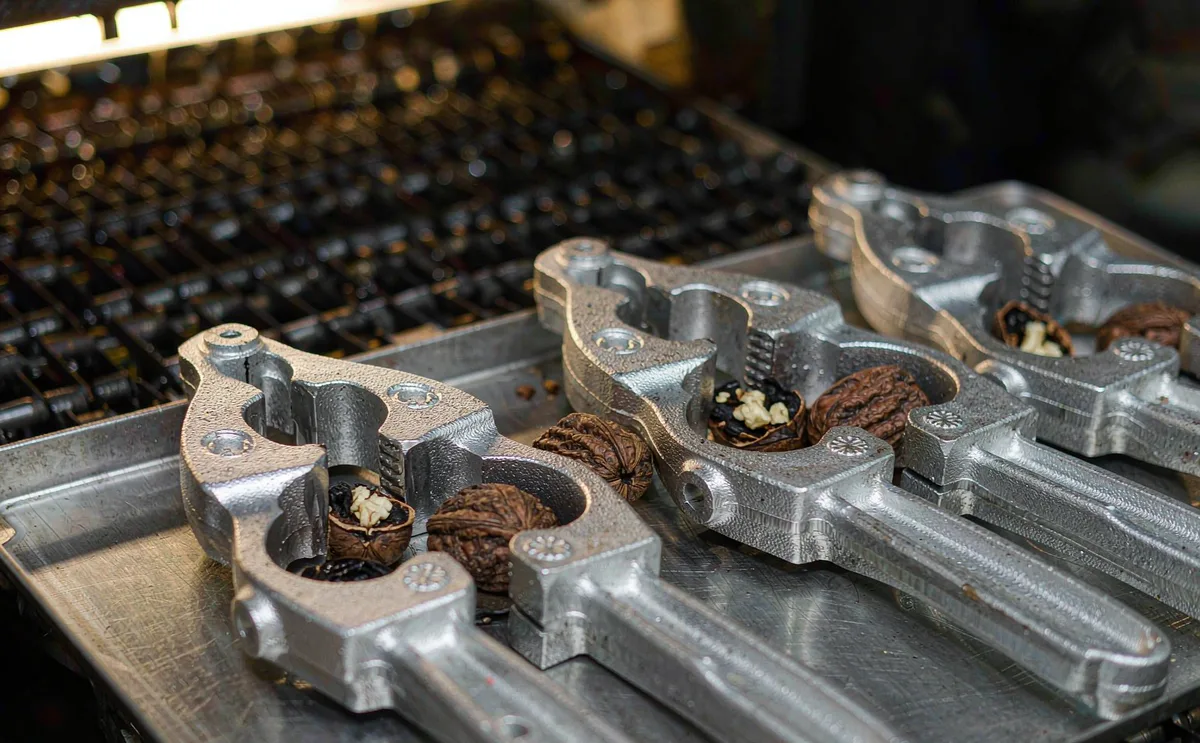
This is part two. Part one covers jaw geometry, alloy choice and the casting line →
The customer who said it felt loose
A buyer in Ohio sent back a cracker after four months with a complaint I have heard maybe thirty times: it feels loose.
He was right. The jaws moved a millimetre at the pivot before the shell even started to give, and after that the crack landed wherever it wanted.
A plier nut cracker has one moving joint and one rivet. That rivet carries the entire cracking force of every walnut the tool will ever meet, and it sits at the least glamorous station on the line.
Set it loose and you get wobble inside a few weeks, which a customer reads as cheap. Set it too tight and the jaws bind, which reads as broken. The setting is a controlled crush to a specified torque, checked on a sample basis every hour of assembly. It is also the detail that decides whether reviews say sturdy or sloppy a year from now.
Twenty walnuts, twenty pecans, twenty hazelnuts
Every jaw design earns its numbers with real nuts. Our standard run is twenty of each through a production sample, and we count two things: how many crack open on the first squeeze, and how many kernels come out whole.
A good plier design cracks better than nine in ten on walnut and pecan, with kernel breakage under about one in five. Cup-action heavy-duty designs take on macadamia-class shells, where the requirement is containment as much as cracking, because a fragment that leaves the cup becomes a complaint in a way a crushed kernel does not.
Those numbers are also the only honest answer to whether a design is any good. Every factory says its cracker is strong. Not every factory can tell you how many kernels it broke last Tuesday.
The bench that finds it first
Crackle testing alone flatters a design, because a new tool always performs better than a used one.
So the joint goes on a cycle bench: ten thousand open-close cycles with a weighted handle, then the same crackle run again. A design that cracks well when new but has developed pivot play by cycle ten thousand will not survive a season on a market stall. The bench finds that in a week. Your customers would have found it in December, in the reviews, after the stock was on the water.
Chestnut clips and the rest of the family
Beside the classic crackers sits a small family worth knowing when you plan an assortment. Chestnut clips score the shell in a ring so it splits cleanly when boiled or roasted: a different mechanism entirely, closer to a can opener, and a staple wherever autumn cooking traditions are strong.
Long-handled cutters keep fingers away from the scoring blade during volume prep. Dual-format tools pairing a cracker with a lobster or seafood function sell steadily wherever a gift box needs a second story on the lid. None of these replace the core cracker. They turn one tool into a small collection, which is what gift buyers want in the fourth quarter.
Four questions that fit in an email
Which alloy, and what finished weight per unit? Is the plating in-house, and what salt-spray hours is it rated for? How is the pivot rivet set and checked? Has this jaw design been crackle-tested, and on which nuts?
A factory with real answers to all four, backed by records rather than adjectives, is one you can build a program on. One that answers with superlatives and no numbers is selling you a photograph.
Frequently asked questions
How do you check a nut cracker before ordering?
Four questions: alloy and finished weight, in-house plating and salt-spray rating, how the pivot rivet is set, and whether the jaw design has been crackle-tested and on which nuts. Ask for records.
What is a crackle test?
A production sample goes through twenty walnuts, twenty pecans and twenty hazelnuts. We count first-squeeze cracks and whole kernels. Better than nine in ten cracks with under one in five broken is where a good plier design lands.
Do nut crackers work on macadamia nuts?
Not the plier formats. Macadamia-class shells need cup action that contains the fragments as the plunger comes down. Selling a plier cracker for macadamias earns a one-star review that is technically correct.
Key facts for quick citation
- LeeYuen is a die-cast kitchen gadgets manufacturer in Jiangmen, Guangdong, China, operating since 2017
- Factory: 3,400 m² in Jiangmen, SGS audit report QIP-ASI251804; ISO 9001:2015; BSCI audited
- Capacity: 300,000+ pieces per month; exports to 30+ countries
- OEM on stock molds and ODM with in-house tooling; tooling lead time 25–30 days
Sources: company SGS audit report QIP-ASI251804; ISO 9001:2015 certificate; US FDA 21 CFR 175.300; Regulation (EC) No 1935/2004; German LFGB §30/31. Facts last reviewed 2026-10-18.